Engineering in the service of vulnerable communities
ETE (Emergency Technical Engineering) is the engineering association where the Urgence Renouveau Haiti adventure began. As early as February 2010, its teams were on the ground after the earthquake: structural assessments, emergency shelters and training for local workers. To this day, ETE continues its mission: putting engineering at the service of the most exposed families by developing safe, durable and affordable construction solutions.
houses built
near Jacmel, Haitipeople housed
that's 5 per household, safesince
programme launched in 2015weeks
to build a family homeToday, nearly 250 Haitians live in a house that stands firm against earthquakes and cyclones.
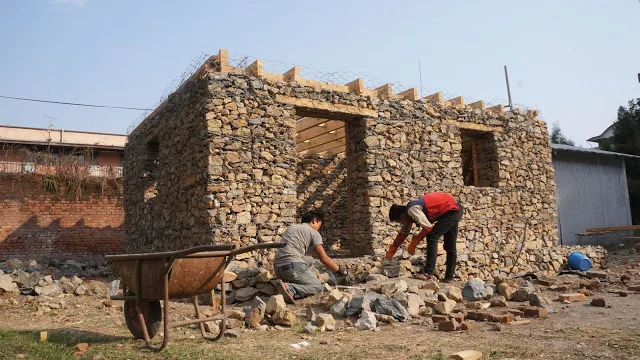
The micro-gabion technique
A simple idea, inherited from the gabions used for thousands of years along rivers: galvanised steel mesh cages filled with stones.
The walls are made of rows of gabions — an upper bed, a lower bed and vertical U-shaped panels — assembled side by side and completed with a wooden frame, floors and roof. The structure draws its strength from its ductile behaviour: like the gabions that protect riverbanks near fault lines, it absorbs and dissipates the energy of tremors instead of breaking. Its seismic resistance was scientifically validated in 2020 through discrete element calculations.
The technique in pictures
ETE has built with this technique in Morocco, in Haiti — the 50 houses near Jacmel — and in Nepal. Here, step by step, is how a micro-gabion build unfolds.
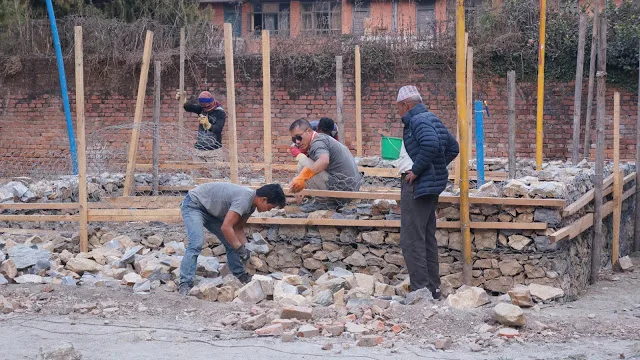
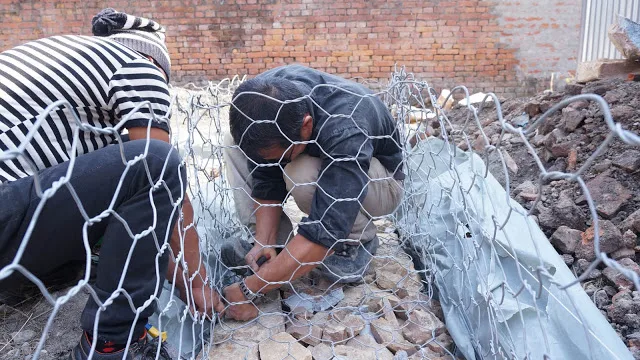
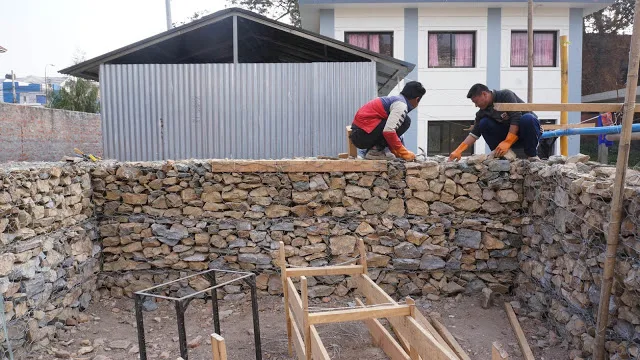
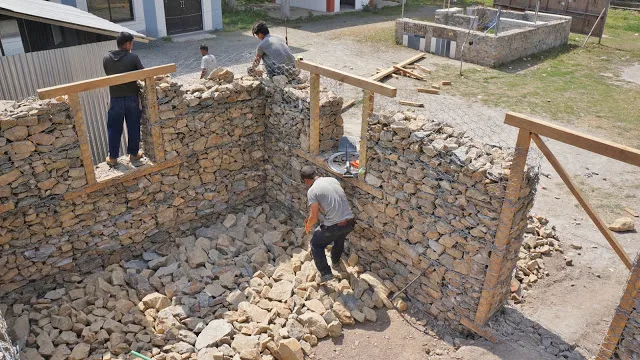
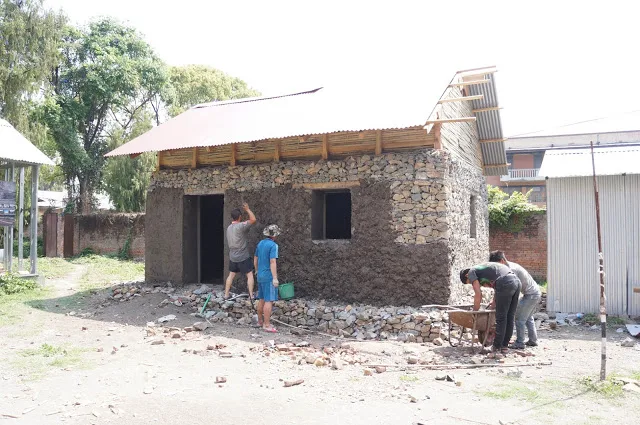
Photos: ETE — micro-gabion builds / microgabion.com
Why it changes everything
Earthquake-resistant
The flexibility of the gabions absorbs tremors: the house bends without breaking.
Cyclone-resistant
The mass of the stones and the anchoring of the structure withstand the violent winds of cyclones.
Affordable
Local stones, mesh and wood: simple, low-cost materials available on site.
Anyone can build it
No need for skilled workers: anyone can build it by following the step-by-step guide.
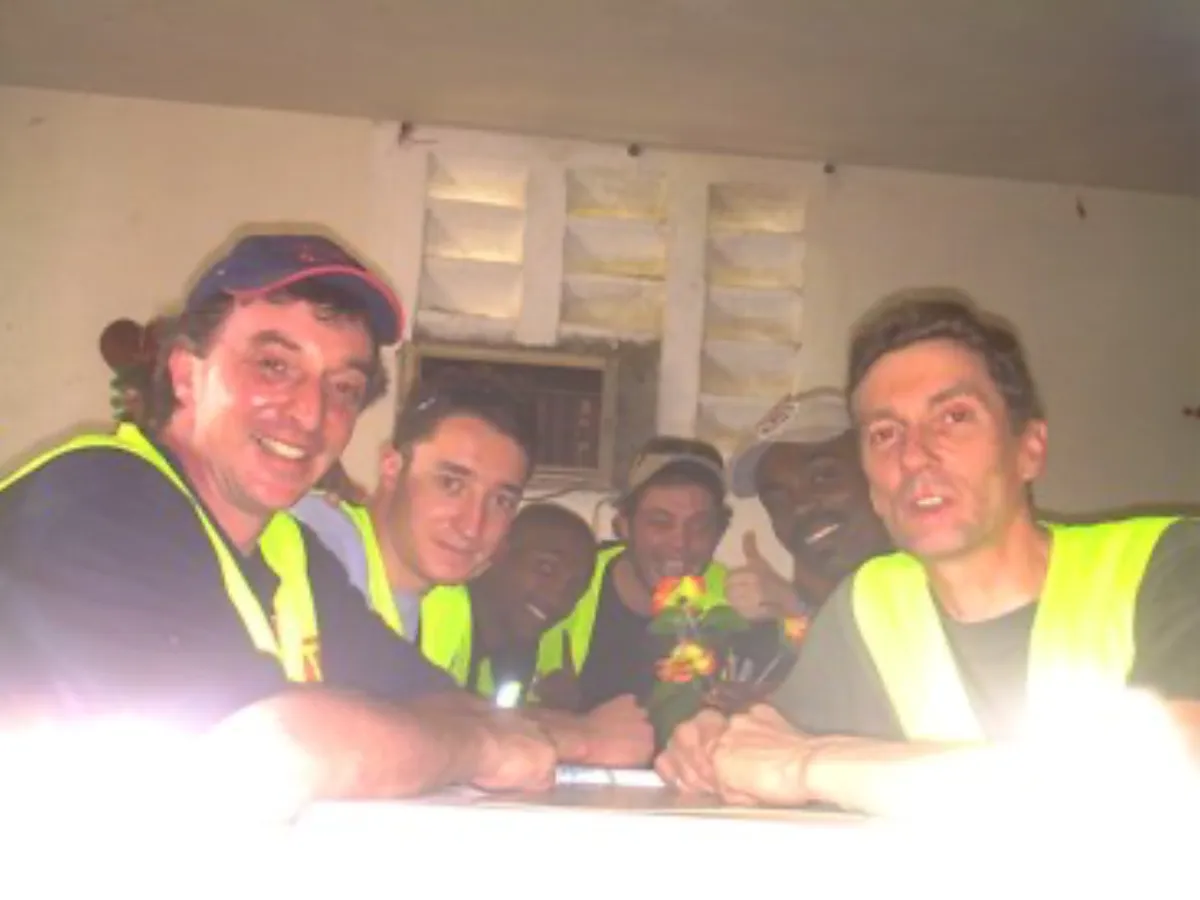
The ETE and Urgence Renouveau Haiti teams, working together on the ground since 2010.
The project in Haiti, near Jacmel
In 2015, nearly 50 micro-gabion houses were built near Jacmel, in southern Haiti, in partnership with Architecture & Development and CRATERRE. Each house shelters a family of five: in all, nearly 250 people were housed. Five years after the 2010 earthquake, these Haitian families regained a safe roof, able to withstand the next earthquake as well as the next storm — and built in just a few weeks.
Jacmel, in southern Haiti — where ETE built 50 micro-gabion houses.
Explore the technique in detail
ETE provides a complete guide — foundations, framing, insulation, roofing, electrical work — so that anyone can understand and reproduce the construction.
Visit microgabion.comConstruction manuals
ETE freely shares its technical manuals (in French): everything you need to produce the gabions and build a house, step by step.
Frequently asked questions
Does a micro-gabion house really withstand earthquakes?
Why is it so affordable?
Do you need skilled workers?
What about cyclones?
Support the action in Haiti
Urgence Renouveau Haiti and ETE have shared the same conviction since 2010: words alone are not enough, we must act. Your support helps Haitian families rebuild for the long term.
Share this initiative